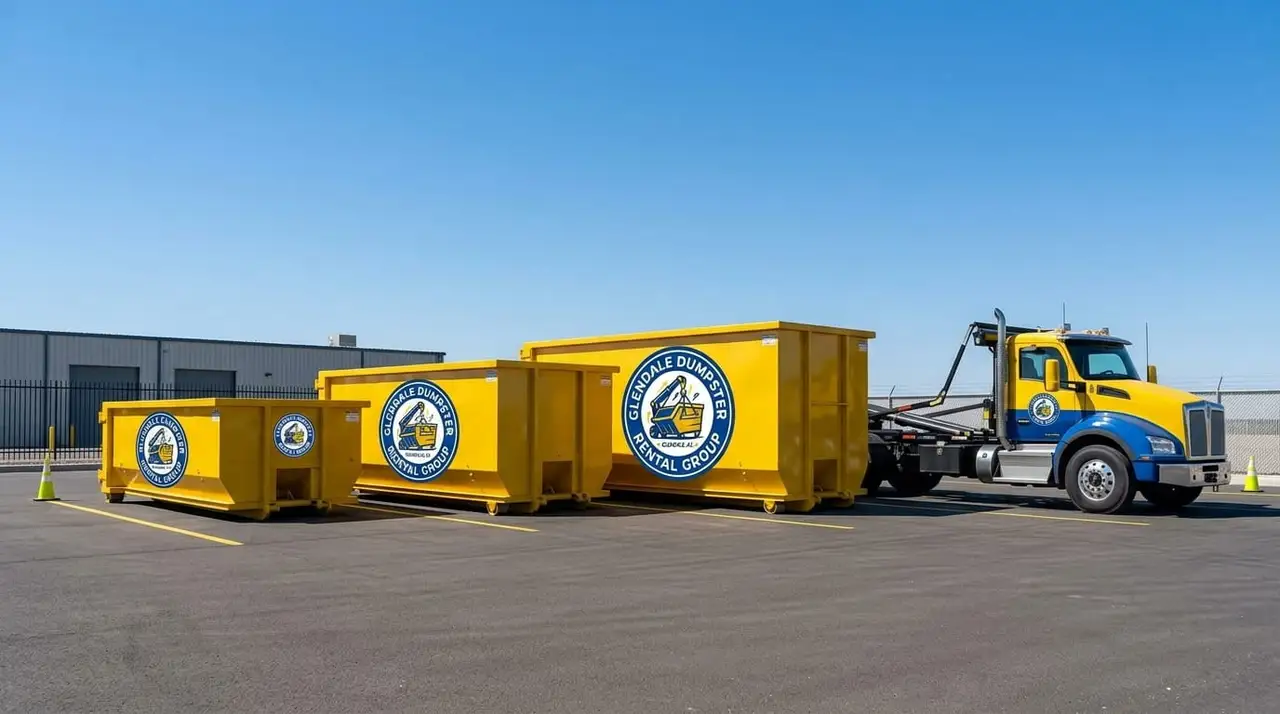

Do You Need a Dumpster Permit in Glendale, AZ?
The honest answer: private-driveway placement almost never needs a permit. Street or right-of-way placement is a different, town-by-town conversation.
ReadRules guide
A straight answer on what's allowed, what isn't, and where the prohibited stuff actually needs to go instead — before it costs you a charge-back fee.

Most of what fills a residential or renovation dumpster is completely unremarkable — furniture, drywall, flooring, cardboard, yard debris. The list of what is not allowed is short, but it matters, because prohibited material found in a load gets pulled and charged back rather than simply hauled away.
General construction and demolition debris (wood, drywall, flooring, roofing shingles), household furniture and junk, yard waste like brush and limbs, and clean concrete, brick or masonry all go in without issue. Most residential and renovation loads are some combination of these.
Paint, solvents, oils and other household hazardous waste; tires; batteries; propane tanks and gas cylinders; appliances containing refrigerant (unless arranged in advance); and medical or biohazard waste are excluded from every roll-off, everywhere we deliver. The Arizona Department of Environmental Quality (ADEQ) publishes broader guidance on where each of these categories actually belongs — most have a dedicated recycling or hazardous-waste disposal path rather than a landfill route.
It's not arbitrary. Hazardous liquids can contaminate an entire load and the site it's processed at. Refrigerant-containing appliances require certified handling under federal rules. Tires and batteries have their own recycling streams that a general debris load bypasses. Treating all of it the same as household junk would mean it never gets handled the way it legally and environmentally needs to be.
One that catches people off guard here: Arizona's native plant law protects saguaros and certain other native desert plants. If a landscaping or lot-clearing job involves removing protected native plants, that's regulated by the Arizona Department of Agriculture and isn't simply a "throw it in the container" matter — worth a call before you start.
Electronics, large appliances without refrigerant, mattresses and some furniture with metal springs sometimes have their own handling rules depending on the disposal facility. If you're not sure whether something specific belongs in the container, ask on the phone before it goes in — that one question is a lot cheaper than a charge-back after the fact.
The load gets pulled apart, the prohibited item gets set aside, and a charge-back fee applies to cover the extra handling. It's not meant as a penalty — it genuinely costs more to process a load with hazardous material mixed in, and we'd rather you know that up front than find it on an invoice.
Talk to a real person
Call (623) 235-8274 and describe the job. Flat price, stated tonnage allowance, and a delivery window on the same call.
Mon–Sat 7:00am – 6:00pm
From this guide
It gets pulled and charged back, since it changes how the load has to be handled and disposed of. Asking before it goes in avoids the fee entirely.
Dried latex paint is sometimes treated differently than liquid paint, but the safest move is asking us directly rather than guessing — oil-based paint and any partially liquid can is treated as hazardous regardless.
Maricopa County periodically runs household hazardous waste collection events, and the Arizona Department of Environmental Quality (ADEQ) publishes broader guidance on disposal. Ask us on the call and we will point you toward the right option for what you have.
Keep reading
The honest answer: private-driveway placement almost never needs a permit. Street or right-of-way placement is a different, town-by-town conversation.
ReadThe complete sizing guide: how to pick the right container by matching your debris to the two limits that actually matter — volume and weight.
ReadOriginal 1960s and 70s kitchens are still coming out across Glendale. Here's how to size and sequence the container for one properly.
Read